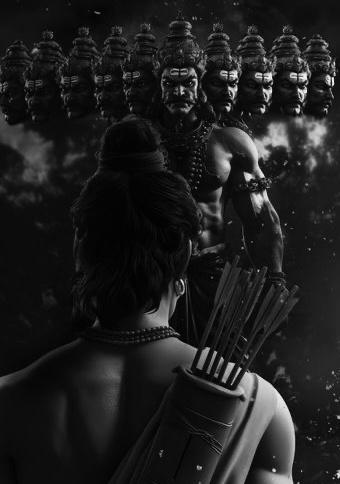
We burn the effigy every year. What if the real work is burning what’s hollow within us?
Every year we burn Ravan. Every year, we go home with our own ten heads intact.
Every year, Ravan’s effigy burns in flames, his ten heads collapsing into ash. We cheer, we clap, we go home. But what if those ten heads were never only his? What if they were mirrors, reflections of the very demons we carry within?
Demons we carry within
Have we ever thought of that?
I guess not.
Ram had everything. If he had wanted, he could have done anything. He was the heir of Ayodhya, and the crown was only a day away. Yet when exile came, he accepted it without bitterness, without a single complaint. He chose to follow the rules of Vanvas, giving up the throne for the sake of his father’s word.
Fourteen years in the forest, with no palace, no comfort, no army of his own. And even when Sita was taken, he didn’t rush into rage. He built alliances with humility. He trusted Hanuman, Sugriv and an army of vanaras, and he gave Ravan a chance to make peace through Angad before a single arrow was fired.
He fought his battle with utmost respect, strength and faith. Respect for the rules of war, strength that never turned into cruelty, and faith that the right path, however long, would lead somewhere. Even at the end, in popular tradition, he asked Lakshman to go to the fallen Ravan and learn from his wisdom. He had defeated the king, but he still honoured the scholar.
On the other hand, Ravan was not weak. He was one of the greatest scholars of his age, a warrior unmatched in valor, a king of immense power, and a true devotee of Lord Shiva. He mastered the Vedas, the veena, and the art of governance. Yet a man who conquered kingdoms could not conquer his own mind. His downfall did not begin with Ram’s arrows. It began the day his negative energy grew louder than his positive one.
One way of reading the ten heads is as ten inner flaws, weaknesses that live in every human heart, and each one visible in Ravan’s own story:
Kaam (Lust): Uncontrolled desire that blinds wisdom. It led him to Sita’s abduction, and from that one act, everything he built began to crumble.
Krodh (Anger): Rage that clouds judgment. Even when Angad came with a final offer of peace, anger made him choose war.
Mada (Intoxication of success): Power so loud that he stopped hearing anyone. Vibhishan’s wise counsel was met with insult and exile.
Moha (Attachment): Clinging to Lanka, to his possessions and his image, bound in illusion, even as sons and brothers fell one by one.
Lobha (Greed): An endless thirst for wealth and power. Gold-laden Lanka was never enough.
Matsarya (Envy): Resentment that poisons the heart and makes us blind to the blessings we already hold.
Ahamkara (Ego): The belief that no one could ever defeat him. Inflated self-importance blinds us to truth.
Jadata (Insensitivity): Disregard for the suffering of others. Sita’s tears and Mandodari’s pleas never reached him.
Ghrina (Hatred): Animosity that consumes the soul and leaves no room for wisdom.
Bhaya (Fear): The dread of losing power and possessions. Behind all the roaring was a man terrified of losing it all.
We all carry at least one of these faces.
Have we ever thought that burning them would make us better human beings?
While we celebrate as the effigy burns, have we ever stopped to look at our own faces?
Ravan’s true defeat was not on the battlefield. It happened quietly, one choice at a time, long before the war began.
Ram was not the strongest, according to Ravan.
But yet, Ram was the steadiest…
Ravan saw only a man in exile. He never saw the steadiness.
He chose restraint over impulse, duty over desire, humility over pride. His strength was never loud. It was disciplined.
Every coin has two sides, positive and negative, and so does every one of us. No matter how difficult the path becomes, no matter how much criticism you face, the question is the same: which side will you feed? Whichever you feed will grow. Choose trust. Choose truth. Never let your negative overpower your positive.
Ravan didn’t fall because Ram was powerful. He fell because he stopped choosing the best version of himself.
And that is the real Dussehra. Not the burning of an effigy, but the quiet decision to burn what is hollow within us.
Because in the end:
Tu hi Ram hai, tu hi Ravan hai.
Ram bhi tu hai, Ravan bhi tu hai.
Krodh bhi tu hai, shanti bhi tu hai.
Nirasha bhi tu aur asha bhi tu.
Bas ab tujhe chunna hai*
This Dussehra, I’m not just watching the effigy burn. I’m asking which head is mine. If this made you pause, tell me in the comments which face you’re working on. And if you know someone who needs this reminder, share it with them
Leave a Reply